

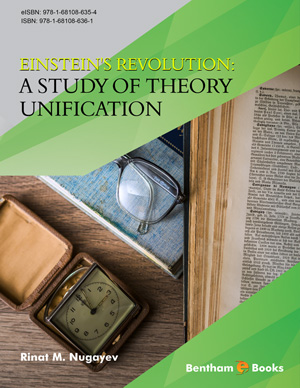
Abstract
The aim of the chapter is to amend the received view on the general theory of relativity (GTR) genesis and advancement by taking into account common scientific practice of its functioning, the history of science data and certain philosophy of science arguments. The inter-theoretical aspect of the GTR genesis as an instance of perspicuous epistemological model of mature theory change that hinges upon ‘old’ theories encounter and interaction is scrutinized. I strengthen arguments in favour of the tenet that the dynamic creation of GTR had been continually governed by internal tensions between two research traditions, that of special relativity and Newton’s gravity. The encounter of the traditions, their interpenetration and intertwinement engendered the rival programmes of relativistic theory of gravity construction: the programmes of Abraham and Nordstrӧm – on the one hand – and Einstein’s programme – on the other. The encounter created the hybrid realm at first with an irregular set of theoretical models. The rival approaches of Einstein, Abraham and Nordström grew closer and eventually were transformed by Einstein into complementary ‘mathematical’ and ‘physical’ strategies of a general synthetic research programme that put forward the Entwurf and the GTR. Step by step, on eliminating the contradictions between the models contrived, the hybrid set was put into order by Einstein via the principle of equivalence. As in the STR case, Einstein was able to freely juxtapose Nordstrӧm, Abraham’s and his own non-metric theoretical schemes without reducing one to the others. It is contended that the main reason for the GTR ‘victory’ over the rival programmes of Abraham and Nordström was a synthetic character of Einstein’s programme. Einstein’s programme did supersede the rival ones because it did ingeniously assimilate some ideas of the Nordström programme as well as some presuppositions of the programme of Abraham. Einstein had put forward as a basic synthetic principle the principle of equivalence that radically differed from that of rival approaches by its open, flexible and regulative character. As a result of reconciling and amalgamating the ‘physical’ and ‘mathematical’ approaches, embodied in Abraham, Einstein and Nordström’s crossbred theoretical models , Einstein was able to explain the anomalous motion of Mercury.
Keywords: Abraham, Besso, Cartan, Christoffel, Einstein, Entwurf, Fokker, General relativity, Grossmann, Hybrid models, Laue, Levi-Civita, Maxwell, Mie, Minkowski, Neo-Kantian epistemology, Nonmetric theories, Nordström, Perihelion of Mercury, Planck, Principle of equivalence, Renn, Riemann, Special
Related Journals
Current Physics
Related Books

Practical Handbook of Thermal Fluid Science

Digital Signal Processing in Experimental Research
Frontiers in Nuclear and Particle Physics

Frontiers in Nuclear and Particle Physics

Advances in Classical Field Theory
Open Quantum Physics and Environmental Heat Conversion into Usable Energy

Open Quantum Physics and Environmental Heat Conversion into Usable Energy
Open Quantum Physics and Environmental Heat Conversion into Usable Energy
Progress in Computational Physics (PiCP)

Progress in Computational Physics (PiCP)