

Impact Factor
Current: 1.7
5 - Year: 1.6
Ranking & Category
- 57th of 59 in Chemistry, Medicinal
- 96th of 105 in Computer Science, Interdisciplinary Applications
Aims & Scope
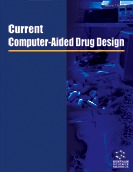
Current Computer-Aided Drug Design aims to publish all the latest developments in drug design based on computational techniques. The field of computer-aided drug design has had extensive impact in the area of drug design.
Current Computer-Aided Drug Design is an essential journal for all medicinal chemists who wish to be kept informed and up-to-date with all the latest and important developments in computer-aided methodologies and their applications in drug discovery. Each issue contains a series of timely, in-depth reviews/mini-reviews, original research articles and letter articles written by leaders in the field, covering a range of computational techniques for drug design, screening, ADME studies, theoretical chemistry; computational chemistry; computer and molecular graphics; molecular modeling; protein engineering; drug design; expert systems; general structure-property relationships; molecular dynamics; chemical database development and usage etc., providing excellent rationales for drug development.
Abstracted & Indexed in:
Archiving and Copyright:
Journal Database:
"The first issue of the journal Current Computer-Aided Drug Design is reflective of the course taken by the editor on the broadest possible coverage of the methodology development and applications of modern computational drug discovery. It is a must-read periodical for the professionals, educators and students interested in this important field."
Alexander Tropsha
Univ. of North Carolina, USA

Related Journals
Anti-Cancer Agents in Medicinal Chemistry
Current Analytical Chemistry
Current Bioactive Compounds
Combinatorial Chemistry & High Throughput Screening
Current Medicinal Chemistry

Central Nervous System Agents in Medicinal Chemistry

Letters in Drug Design & Discovery
Current Drug Discovery Technologies
The Natural Products Journal
Current Catalysis
Related Books
Botanicals and Natural Bioactives: Prevention and Treatment of Diseases
Biosurfactants: A Boon to Healthcare, Agriculture & Environmental Sustainability
Frontiers in Computational Chemistry

Advances in Dye Degradation

Biological and Medical Significance of Chemical Elements
Frontiers In Medicinal Chemistry
Advances in Organic Synthesis
Frontiers in Natural Product Chemistry

Recent Advances in Analytical Techniques

Advanced Catalysts Based on Metal-organic Frameworks (Part 2)
