

Bentham is offering subject-based scholarly content collections which are tailored to meet specific research needs. Researchers can access related articles from current and back volumes by purchasing access to these collections. Subscribers will also have access to new articles as soon as they are published and added to these collections. With new articles being added to these collections on a daily basis, the collections serve as an ideal tool to keep researchers updated with new developments in the respective fields.
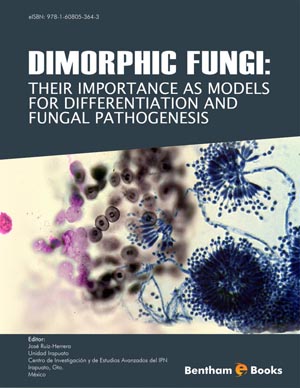
DOI: 10.2174/97816080536431120101 eISBN: 978-1-60805-364-3, 2012 ISBN: 978-1-60805-510-4
Back Recommend this Book to your Library Cite as
Cite this Book as:
For Books José Ruiz-Herrera , " Dimorphic Fungi: Their Importance As Models For Differentiation And Fungal Pathogenesis ", Bentham Science Publishers (2012). https://doi.org/10.2174/97816080536431120101
DOI https://doi.org/10.2174/97816080536431120101
Publisher Name Bentham Science Publisher
Print ISBN978-1-60805-510-4
Online ISBN978-1-60805-364-3
Page: i-i (1) Author: Rafael Sentandreu DOI: 10.2174/97816080536431120101000i
Page: ii-ii (1) Author: José Ruiz-Herrera DOI: 10.2174/9781608053643112010100ii
Page: iii-iv (2) Author: José Ruiz-Herrera DOI: 10.2174/978160805364311201010iii
Page: 3-15 (13) Author: José Ruiz-Herrera and Eduardo Campos-Góngora DOI: 10.2174/978160805364311201010003 PDF Price: $15
Page: 16-34 (19) Author: Gioconda San-Blas and Gustavo Niño-Vega DOI: 10.2174/978160805364311201010016 PDF Price: $15
Page: 35-45 (11) Author: Margarita Rodríguez-Kessler, María de la Luz Guerrero-González and Juan Francisco Jiménez-Bremont DOI: 10.2174/978160805364311201010035 PDF Price: $15
Page: 46-57 (12) Author: Amalia Porta, Elena Calabrese, Ilaria Granata and Bruno Maresca DOI: 10.2174/978160805364311201010046 PDF Price: $15
Page: 58-66 (9) Author: Juan Francisco Jiménez-Bremont, Aída Araceli Rodríguez-Hernández and Margarita Rodríguez-Kessler DOI: 10.2174/978160805364311201010058 PDF Price: $15
Page: 67-86 (20) Author: Leila M. Lopes-Bezerra and Rosana C. Nascimento DOI: 10.2174/978160805364311201010067 PDF Price: $15
Page: 87-104 (18) Author: V. Ghormade, E. Pathan and M. V. Deshpande DOI: 10.2174/978160805364311201010087 PDF Price: $15
Page: 105-116 (12) Author: José Ruiz-Herrera and Claudia G. León-Ramírez DOI: 10.2174/978160805364311201010105 PDF Price: $15
Page: 117-143 (27) Author: José Ruiz-Herrera DOI: 10.2174/978160805364311201010117
Dimorphism can be defined as the property of different fungal species to grow in the form of budding yeasts or in the form of mycelium, depending on the environmental conditions. Dimorphism may be considered as a differentiative phenomenon, similar to others exhibited by fungi: spore germination, sporulation, etc, but comparatively simple to analyze. Fungal dimorphism involves extensive changes in the cell physiology and morphology in response to external signals, producing drastic alterations in the cell wall structure and synthesis, whose growth pattern changes from isodiametric (spherical) to polarized or vice versa. Because of this, dimorphism has been the subject of extensive studies as a model for the differentiation processes occurring in eukaryotic organisms. Additionally, it is important to recall that the most important human pathogenic fungi, and some plant pathogenic ones are dimorphic, displaying different morphologies when growing as saprophytes, or inside their hosts. This observation, and the demonstration that mutants in specific genes that interfere with the dimorphic transition are non-virulent, has suggested that this process might be a target for efficient antimycotic drugs. This e-book includes several chapters on the most important and studied fungal models, written by specialists, discussing the biology of each species or genera, the general aspects controlling their dimorphic transition, the molecular aspects involved, the use of them as models for understanding the bases of biochemical and cell differentiation, and the importance of dimorphism in pathogenesis. This e-book is recommended for scholars and researchers working or interested in human, animal and plant pathogenesis, fungal genetics, molecular biology, development, evolution, and differentiation.
Current Pharmacogenomics
Current Pharmacogenomics and Personalized Medicine
Recent Patents on Biotechnology
Current Molecular Medicine
Current Enzyme Inhibition
Current Signal Transduction Therapy
Current Bioinformatics
Current Public Health
Current Gene Therapy
Current Cell Science
Industrial Applications of Soil Microbes
Biomarkers in Medicine
Biopolymers Towards Green and Sustainable Development
Algal Biotechnology for Fuel Applications
The Wax Moth: A Problem or a Solution?
Taurine and the Mitochondrion: Applications in the Pharmacotherapy of Human Diseases

An Introduction to Mycosporine-Like Amino Acids