

Abstract
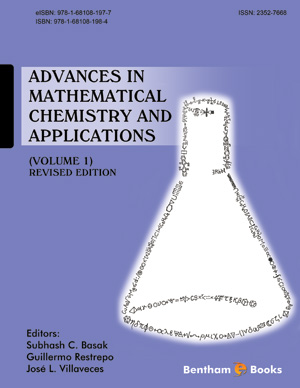
Mathematical chemistry or more accurately discrete mathematical chemistry had a tremendous growth spurt in the second half of the twentieth century and the same trend is continuing in the twenty first century. This continual growth was fueled primarily by two major factors: 1) Novel applications of discrete mathematical concepts to chemical and biological systems, and 2) Availability of high speed computers and relevant software whereby hypothesis driven as well as discovery oriented research on large data sets could be carried out. This led to the development of not only a plethora of new concepts, but also to various useful applications. This chapter will discuss the major milestones in the development of hierarchical QSARs for the prediction of physical as well as biological properties of various classes of chemicals by the Basak group of researchers using mathematical descriptors and different statistical methods.
Keywords: Property-activity relationship (PAR), graph theory, molecular graphs, weighted pseudograph, graph theoretic matrices, adjacency matrix, distance matrix, topological indices, topostructural indices, topochemical indices, information theoretic indices, connectivity indices, valence connectivity indices, E-state indices, quantum chemical descriptors, hierarchical quantitative structure-activity relationship (HiQSAR), partial least square (PLS), principal components regression (PCR), principal components analysis (PCA), ridge regression (RR), naïve q2, true q2, proper cross validation, leave one out (LOO) method, Envelope models, interrelated two-way clustering, linear discriminant analysis, mutagenicity, congenericity principle, diversity begets diversity principle, big data.
Related Journals
Current Chinese Science
Anti-Cancer Agents in Medicinal Chemistry
Current Computer-Aided Drug Design
Current Bioactive Compounds
Current Medicinal Chemistry
Current Topics in Chemistry
The Natural Products Journal
Current Catalysis
Current Chinese Chemistry
Combinatorial Chemistry & High Throughput Screening
Related Books
A Journey Through Water: A Scientific Exploration of The Most Anomalous Liquid on Earth
Advances in Mathematical Chemistry and Applications

Advances in Mathematical Chemistry and Applications

Advances in Organic Synthesis
Advances in Organic Synthesis
Advances in Organic Synthesis
Advances in Organic Synthesis
Advances in Organic Synthesis
Advances in Organic Synthesis
Advances in Organic Synthesis