

Abstract
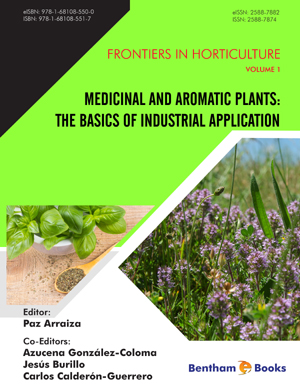
Two thujone free Spanish populations of Artemisia absinthium from Teruel and Sierra Nevada (Spain) were submitted to a domestication process. The domestication resulted in lower chemical variation and higher biomass and essential oil yields, allowing for the registry of a new domesticated variety (® Candial). The main components of the new variety essential oil extracts were cis-epoxyocimene, chrysanthenol, chrysanthenyl acetate, trans-caryophyllene and linalool. The presence of 1.8-cineol and camphor correlated with the domestication level of A. absinthium. CO2 supercritical fluid extraction, improved the yield of (Z)-epoxyocimene, chrysanthenol, (5Z)-2,6-dimethylocta-5,7-diene-2,3-diol and trans-chrysanthenyl acetate. The development of extraction processes with supercritical CO2 allowed for the enrichment of desired bioactive compounds in A. absinthium extracts. The superctitical extracts showed strong antifeedant and insecticidal effects against Spodoptera littoralis, indicating that for insect control purposes supercritical CO2 extraction should be used. The semi-industrial vapor-pressure extracts (VPs) showed strong antifungal effects. (-)-cis-chrysanthenol has been identified as the chemical indicator of the antifungal quality of VP extracts from A. absinthium (® Candial). These VP extracts also showed a high nematocidal activity against animal parasitic nematode Trichinella spiralis without being cytotoxic to macrophage cells. These oils showed activity on the protozoan parasites Trypanosoma cruzi and Trichomonas vaginalis. The antiprotozoal activity of the VP oil was related with the presence of trans-caryophyllene and dihydrochamazulene. EOs from cultivated A. absinthium could be considered as potential candidates for development of new antifungal and insect antifeedant agents, as well as drugs against helminth and protozoan parasites.
Keywords: Antifungal, Artemisia absinthium, Chrysanthenyl acetate, (-)-Cis- Chrysanthenol, Cis-epoxyocimene, Dihydrochamazulene, Domestication process, Insect antifeedant, Linalool, Supercritical CO2, Trans-caryophyllene, Trichinella spiralis, Trichomonas vaginalis, Trypanosoma cruzi.
Related Books
Industrial Applications of Soil Microbes
Industrial Applications of Soil Microbes
Biomarkers in Medicine

Biopolymers Towards Green and Sustainable Development
Algal Biotechnology for Fuel Applications
The Wax Moth: A Problem or a Solution?
Taurine and the Mitochondrion: Applications in the Pharmacotherapy of Human Diseases
An Introduction to Mycosporine-Like Amino Acids
Bioremediation for Environmental Pollutants
Bioremediation for Environmental Pollutants